
Unified Inventory Intelligence To Drive Action

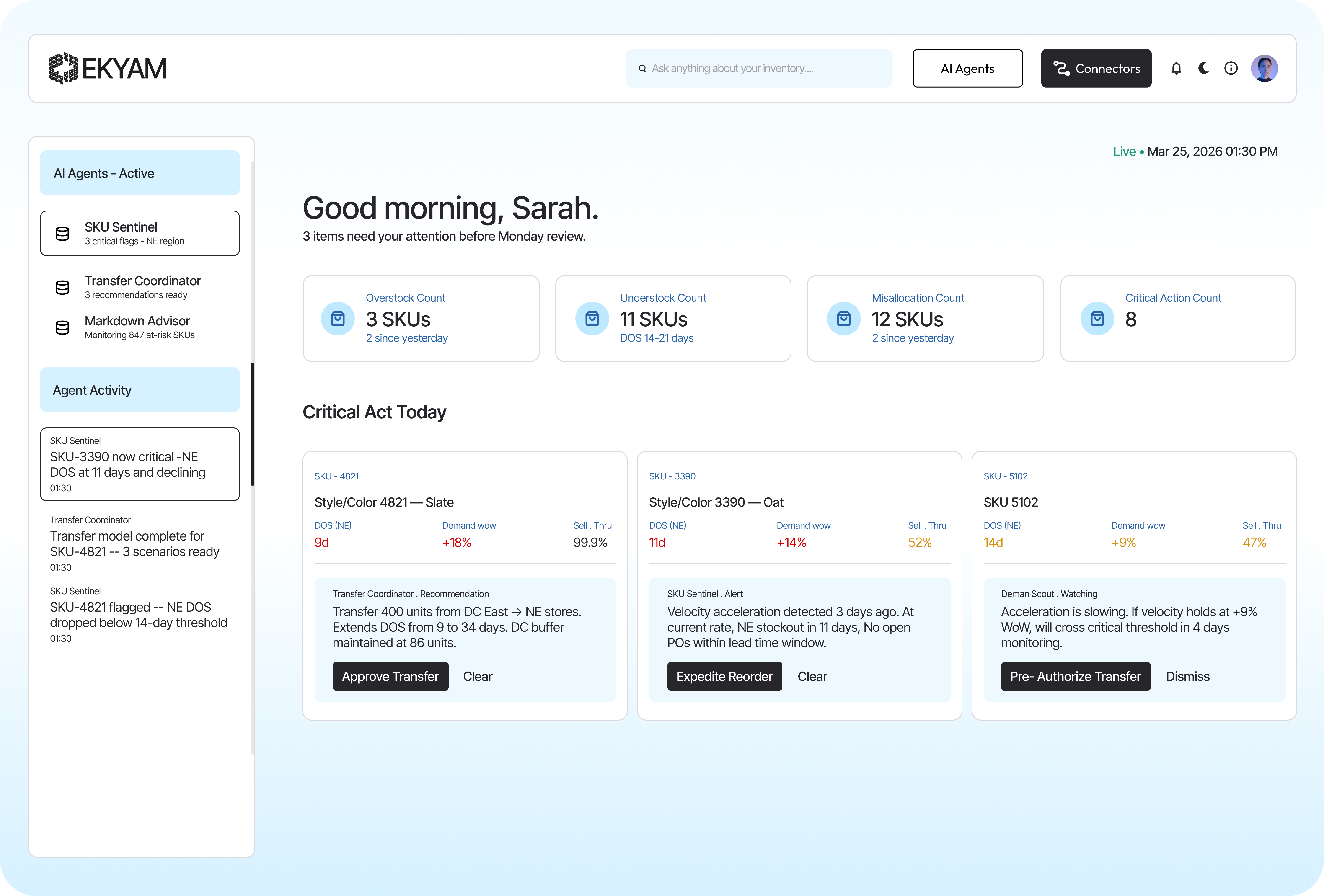
Transform fragmented inventory data into a unified source of truth — accessible in real time to every team and AI agent across your stack. Eliminate manual reconciliation, surface actionable insights, and trigger proactive actions before inventory exceptions become losses.

Get Smarter
Hero Banner

Introducing Ekyam’s Agent Library

logo

Agentic Automation

Deploy Ekyam's library of standard retail agents — pre-built to monitor inventory positions, flag at-risk SKUs, trigger replenishment recommendations, and escalate exceptions before they become losses. Or launch purpose-built agents configured to the specific workflows, thresholds, and decisions your business runs on. Routine operations are automated, freeing your team to focus on the exceptions and decisions that protect margin and unlock revenue.

logo

Customizable Views

Give every user a view built around the metrics they own and the actions they can take. Ekyam dashboards are configured by role — merchant, planner, allocator, ops — surfacing the right inventory signals, exception queues, and decision triggers for each person, without the noise of everything else. Less time in reports. More time acting on what matters.
logo

How Ekyam’s Portfolio of Agents
Become Your Competitive Advantage

logo

Faster, Smarter Decision-Making

Get real time insights into inventory performance and critical SKU level exceptions. Drastically reducing the time required to take action.

logo

Enhanced Operational Efficiency

Automate and schedule routine queries and workflows
(stock checks, vendor performance, pricing analysis), and spend less time gathering data and more time optimizing operations, planning promotions, and managing suppliers.

logo

Removing Information Bottlenecks

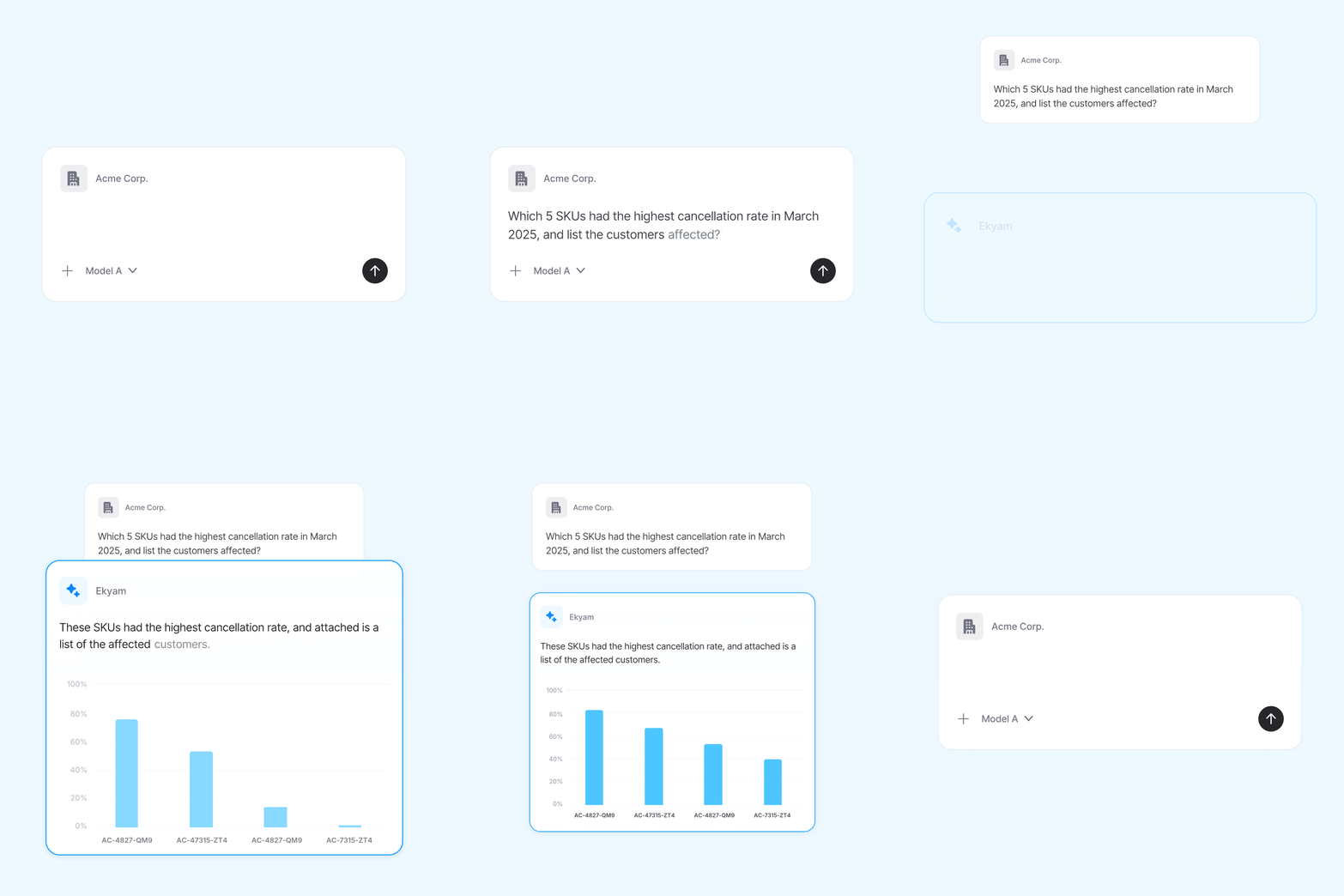
Ekyam’s agents deliver a single view of data real time across the organization, removing roadblocks in daily operations and the need to search multiple systems or wait for an analyst.

logo

Accelerated Response to Business Needs

From inventory adjustments to promotional planning, 
teams can act faster because actionable insights are available on demand, reducing delays in decision cycles.

Ekyam Agent Library

Inventory Intelligence, Built to Act.

Total Agents28
Categories5

Supply & Inbound

8 agents

Inbound Reconciliation

One agent, two workflow triggers. Pre-receipt: compares PO against ASN, flags quantity gaps, substitutions, and damage claims before goods arrive at DC. Post-receipt: compares physical receipt against ASN and posts accepted variances back to ERP. Replaces ASN Reconciliation and PO Discrepancy.

Actions

Cancel Window

Monitors open PO cancel dates against vendor ship confirmations. Flags the cancel-or-commit decision before the window closes with financial exposure calculated from governed cost and unit data. Once the cancel date passes, the brand is financially committed.

Actions

Substitution Confirmation

Pulls substitution flags from ASNs, matches against original PO, calculates accept vs. reject impact against current inventory position. Routes the decision with full context before receiving — not an email chain disconnected from the PO record.

Actions

Receipt Readiness

When receipts are confirmed as shipped, pre-runs allocation logic and flags issues before goods arrive — OTB gaps, size run problems, presentation minimum shortfalls, channel designation conflicts. The planner sees the problem 10 days out, not the morning it lands.

Actions

Duplicate Commitment

Two detection modes, one agent. Supply mode: monitors for duplicate POs against the same vendor and SKU. Financial mode: monitors for duplicate OTB commitments against the same budget line. Catching either before goods ship costs nothing. Catching either after costs the full landed cost plus markdown to clear.

Actions

Vendor Compliance

Monitors inbound shipments against the brand's routing guide — carrier requirements, carton labeling, EDI timing, packing list accuracy. Flags non-compliance before receipt rather than after the chargeback window opens. Systematic, not dependent on someone at the DC noticing.

Actions

Wholesale POS Lag

When a wholesale account's POS data exceeds its expected reporting window, flags the gap before sellthrough calculations go stale. Late wholesale POS data means reorder decisions are being made on incomplete sell-through information without anyone realizing it.

Actions

EDI Automation

Processes structured and semi-structured inputs — PDFs, Excel files, and emails containing PO updates, shipment delays, and inventory changes — converting them into structured data in the correct EDI or API format. Updates ERP, WMS, OMS, or ecomm directly. Eliminates manual data entry and the synchronization gaps it creates.

Actions

Inventory Operations

8 agents

Transfer Agent

Network-level modeling and execution in one agent. Evaluates DOS and velocity divergence across nodes, models transfer scenarios ranked by revenue at risk, calculates DC buffer impact, and executes approved transfers back into WMS via the middleware layer. The strategic and operational distinction was framing — the work is the same agent.

Actions

Channel Allocation

Continuously monitors velocity divergence across channels. When ecomm outpaces wholesale or stores are underperforming relative to DC availability, surfaces a rebalance recommendation. No forecasting — relative velocity comparison against governed channel position data already in the IDP.

Actions

Store Receiving Confirmation

Monitors store-level receipt confirmations against DC shipment records. When a store hasn't confirmed within the expected window, flags it for the distribution team while the trail is still warm — not discovered during a cycle count two weeks later.

Actions

Ecomm–Store Parity

Monitors for SKUs showing out of stock on ecomm while inventory exists in stores or DC. Surfaces the channel unlock decision before a customer bounces off a stockout page. A channel designation governance issue — the data is all in the IDP, the decision needs to reach the right person fast.

Actions

Size Integrity

Monitors size run completeness at Style/Color level by location. Flags size-out conditions where DOS looks healthy in aggregate but a top-selling size is missing and the style is effectively unsellable. The response is consolidation, not reorder — the units exist, they're in the wrong place.

Actions

Allocation Integrity

After an allocation run executes, validates that what was allocated matches what was intended — correct stores, correct quantities, no distribution logic errors. Catches mistakes before the truck leaves the DC, when correction is still possible without cost.

Actions

Returns Disposition

When returns are processed, surfaces disposition recommendations based on current inventory position and remaining season weeks. A style at 9 DOS shouldn't be sent sellable returns to liquidation. A style at 145 DOS probably should. Decision currently happens in WMS with no merchant visibility.

Actions

Order Integrity

Continuously reconciles sales orders across all connected systems to ensure every order is captured and processed correctly. When a failure occurs due to API issues or system downtime, automatically retries, reactivates workflows, or escalates until the order is successfully synchronized across ERP, OMS, WMS, and ecomm platforms.

Actions

Demand & Risk

4 agents

SKU Sentinel

Continuous stockout risk monitoring across the full SKU population. Ranks by revenue impact, not variance. Evaluates DOS against lead time, season position, velocity trajectory, supply visibility, and in-season receipt phasing. Suppresses alerts on planned gaps, already actioned SKUs, and seasonal items inside their markdown window.

Actions

Sell-Through Risk

Alerts when inventory will stock out before replenishment arrives. Deterministic math: if weeks of supply < lead time + safety buffer, risk alert. Checks seasonal vs. core flag before recommending action type — seasonal items get reallocation or chase; core items get reorder.

Actions

Dead Inventory

Identifies SKUs with weeks of supply >52 and low recent sell-through. Surfaces ranked disposition options before inventory becomes a markdown emergency. Checks seasonal vs. core and whether a vendor return or liquidation channel is available before including those as recommended actions.

Actions

Inventory Leakage Detection

Identifies revenue loss from operational gaps — inventory not available to sell due to unpublished status, missing pricing, channel mapping errors, inventory holds, or feed failures. Quantifies estimated weekly revenue leakage per SKU. Absorbs SKU Availability checks as detection conditions within the broader leakage framework.

Actions

Data Governance

7 agents

Channel Availability Sync

Monitors for ATP divergence between ERP and OMS beyond defined tolerance. Pushes the reconciled governed number back to the divergent system on approval. ATP errors drive customer-facing stockouts on items that physically exist — a data problem presenting as an inventory problem.

Actions

Price Consistency

Monitors retail price across channels and source systems. Flags when a promotional price in one channel isn't reflected in ERP master data. The downstream impact is margin miscalculation in every planning tool — planners making OTB decisions on a cost/retail relationship that no longer reflects reality.

Actions

Data Quality

Monitors the governing layer itself — source system sync failures, unmapped fields in new feeds, metric results outside expected bounds. Infrastructure monitoring for the IDP. What keeps the governed badge on the SKU 360 actually meaning something over time, not just at go-live.

Actions

New Style Setup

Validates all required master data fields are populated before a new SKU goes live — cost, retail, season code, vendor, country of origin, size run, replenishment flag, channel designation. Incomplete master data at setup is the source of a disproportionate share of downstream discrepancies.

Actions

Markdown Compliance

When a markdown is approved and pushed to POS, confirms the price change executed correctly across all intended locations at the right depth and effective date. Catches partial execution — a 30% markdown that only applied in some doors — before the selling window shrinks.

Actions

Intercompany Transfer Docs

For brands across legal entities — monitors cross-entity transfers and flags when required customs, tax, or accounting documentation hasn't been generated within the required window. Prevents finance surprises downstream. Not a compliance tool — a gap-closing one.

Actions

Safety Stock Compliance

For brands designating inventory for wholesale accounts — monitors whether reserves are maintained at designated levels. Flags when free stock has dipped into safety stock territory before an account is inadvertently shorted. The decision to release or protect must be made by a person, not resolved silently.

Actions

Financial & Planning

3 agents

OTB Reconciliation

Monitors the gap between planned OTB in the planning system and committed OTB in the ERP as open POs. Flags divergence beyond threshold — cancellations, substitutions, and period shifts cause these to drift constantly. Planners making OTB decisions on the wrong number create downstream commitment errors.

Actions

OTB Guardian

Before any reorder or transfer recommendation surfaces, checks whether the action is executable within current OTB. Flags OTB-constrained recommendations as requiring an exception rather than presenting them as clean decisions. Without this, merchants receive recommendations they can't act on — which erodes trust in the system.

Actions

Vendor Performance

Tracks fill rate, on-time delivery, and quality claims by vendor over rolling periods. Flags when a vendor's pattern puts current open POs at risk — not just the individual late PO but the pattern across all active commitments. Surfaces before a merchant is surprised at receipt, not after.

Actions
InterTight